The sensors and peripherals in a vehicle speak many languages: I2C and SPI for configuration, MIPI CSI-2 for cameras, proprietary interfaces for radar and lidar, CAN for control. To unify them on one Ethernet network, their data has to be carried inside Ethernet frames — encapsulated — without breaking the devices that rely on it. This is the scope of the NAV Alliance working group TWG4, Protocol Encapsulation for Ethernet.
Key takeaways
- Encapsulation wraps a native protocol’s data in Ethernet frames so it can cross a switched network and be unwrapped at the destination.
- TWG4 targets I2C, SPI, camera interfaces and radar/lidar data, with three principles: backwards compatibility with Ethernet frame formats, extensibility, and no duplication where other relevant standards exist.
- IEEE 1722 (AVTP) already defines formats for video, audio and control-bus tunnelling and is a key building block.
- Timing, latency and error handling must be preserved — especially for control buses that expect immediate acknowledgements.
Why encapsulate at all?
The industry is moving sensors from dedicated point-to-point links to the vehicle Ethernet network, as described in our article on Asymmetrical Ethernet. But the image sensor inside a camera still outputs MIPI CSI-2, and its registers are still configured over I2C. A radar front end may deliver raw ADC samples over a high-speed serial interface. Rather than redesigning every sensor, encapsulation lets these native interfaces ride over Ethernet transparently:
- Video and sensor data are packetized at the sensor and reassembled at the computer.
- Control transactions (I2C reads/writes, SPI transfers, GPIO events) are carried as messages in the opposite direction.
- Timing information (frame start, trigger signals, timestamps) is conveyed so the receiver can reconstruct the original timing relationships.
Design principles defined by TWG4
| Principle | What it means in practice |
|---|---|
| Backwards compatibility with existing Ethernet frame formats | Encapsulated traffic must be ordinary Ethernet frames — standard switches, MACsec, VLANs and diagnostics continue to work without modification. |
| Extensibility and adaptability | The scheme must accommodate new or evolving protocols and sensor types without a redesign. |
| No duplication of existing standards | Where a relevant standard already exists (for example IEEE 1722 formats), it is reused rather than re-invented. |
The building block: IEEE 1722 (AVTP)
IEEE 1722, the Audio Video Transport Protocol, was developed for time-sensitive audio and video over Ethernet and has grown into a general transport for automotive streams. It defines stream formats for compressed and uncompressed video, audio, and — through its Alternative Control Format (ACF) — messages for CAN, LIN, FlexRay, GPIO, serial ports and sensor data. AVTP streams carry a presentation time derived from the gPTP-synchronized network clock (IEEE 802.1AS), so a receiver knows exactly when each sample or frame was captured.
For cameras, encapsulating CSI-2 packets into AVTP or a similar format lets the computer’s receiver reconstruct the CSI-2 stream and feed it into an existing image signal processor. For control, ACF messages carry bus transactions with timestamps.
Encapsulating control buses: I2C and SPI
I2C and SPI are synchronous, master-driven buses. An I2C master expects a slave to acknowledge each byte within microseconds; it may also stretch the clock while waiting. Directly extending that handshake across a network would be impractical. Encapsulation schemes therefore typically use one of two approaches:
- Transaction-level tunnelling: the host sends a complete transaction (“write these bytes to register X of device Y” or “read N bytes”) in one Ethernet message; a bridge at the sensor executes it locally on the I2C/SPI bus and returns the result and status.
- Remote device abstraction: software on the host sees a virtual I2C/SPI controller whose driver translates calls into network messages, keeping existing sensor drivers unchanged.
Either way, the system must handle lost or delayed messages with timeouts and retries, and must protect control traffic — reconfiguring a camera is a security-relevant action, so integrity protection (for example MACsec) is essential.
Radar and lidar data
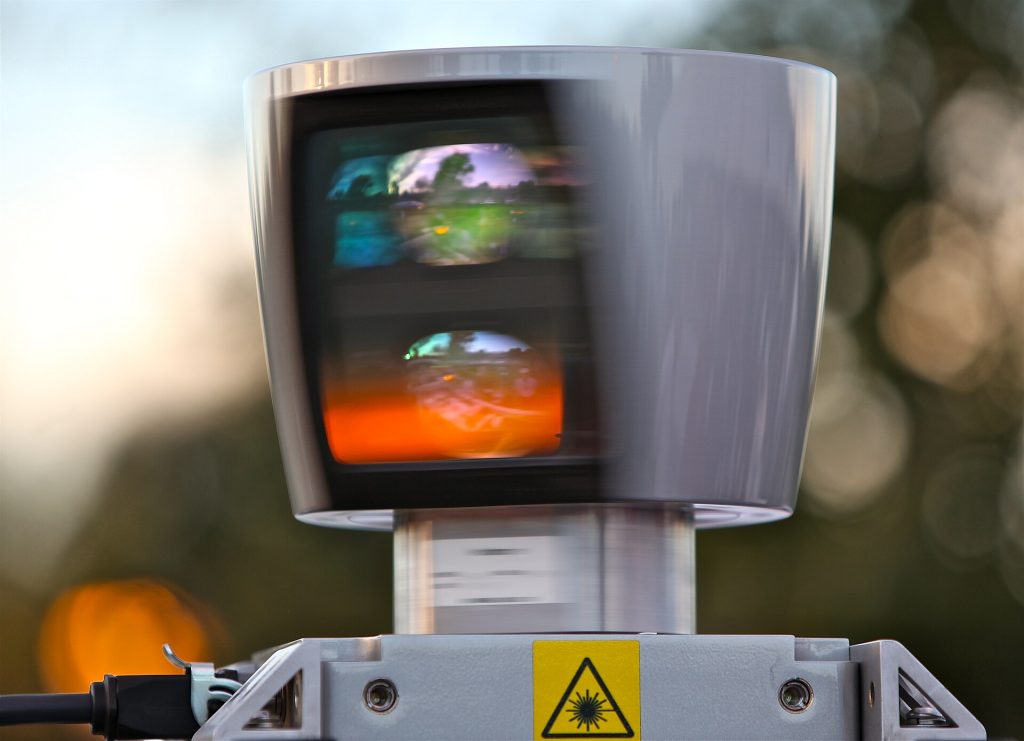
Radar and lidar sensors increasingly move from sending object lists (small, processed data) to sending raw or lightly processed data for central fusion. Imaging radar may stream radar cubes; lidar sends point clouds. These streams are bursty and synchronized to the sensor’s measurement cycle. Encapsulation must preserve measurement timestamps and support efficient packetization of large blocks, while letting the network prioritize them alongside cameras with TSN mechanisms.
Latency, jitter and synchronization
Encapsulation adds a small amount of latency for packetization and buffering, plus switch transit time. For perception pipelines, what matters is that latency is bounded and timestamps are accurate: sensor fusion aligns data by capture time, not arrival time. With gPTP synchronization and TSN shaping, end-to-end latency in a well-designed network is predictable at the microsecond level. See TSN in the vehicle.
Bandwidth efficiency
Headers cost bandwidth. A 1500-byte payload in an Ethernet frame with IP/UDP or AVTP headers plus preamble and inter-frame gap has an overhead in the range of a few percent; small frames have much higher relative overhead. Video encapsulation therefore packs full lines or multiple lines per frame, and some links use larger frames where all devices support them. Our bandwidth calculator lets you include a protocol-overhead percentage when sizing links.
Error handling and diagnostics
- Sequence numbers detect lost frames; video receivers can conceal or flag missing lines.
- Frame counters and checksums let safety software detect frozen or repeated images.
- Control transactions return explicit status codes and are retried on timeout.
- Bridges report statistics through the network management interface defined by the vehicle’s management protocol.
Frequently asked questions
Is protocol encapsulation the same as a gateway?
No. A gateway translates between protocols and often terminates them. Encapsulation carries the native protocol transparently so the endpoints can behave as if directly connected.
Does encapsulation require special switches?
No — that is the point of backwards compatibility. Standard Ethernet switches forward encapsulated frames like any other traffic; TSN features help guarantee timing.
How can I participate in TWG4?
Engineers from Promoter and Contributor companies can join. See Working Groups and Membership.
Updated November 2026.