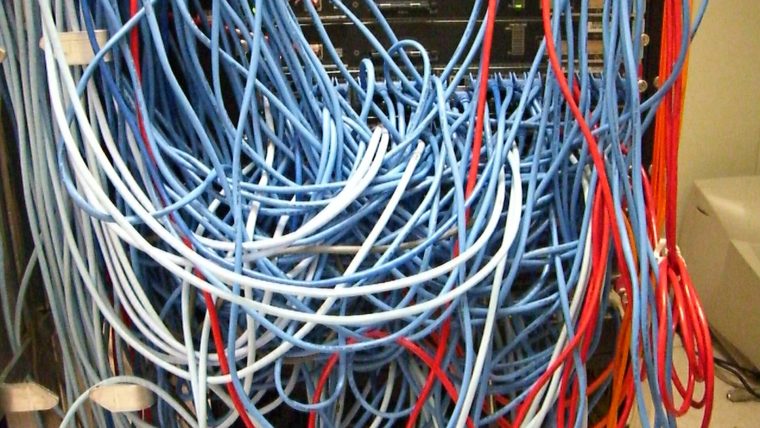
For thirty years, cars gained features by gaining boxes: one electronic control unit per function, each with its own wiring. Premium vehicles reached more than a hundred ECUs and several kilometres of copper. The software-defined vehicle reverses that trend — and the zonal architecture with a Multi-Gig Ethernet backbone is how it is built.
Key takeaways
- Zonal architecture groups devices by physical location instead of by function, cutting wiring length, weight and complexity.
- Zone controllers connect to a few central computers over a high-speed Ethernet backbone, typically 10 Gb/s today and 25 Gb/s or more next.
- Software features become independent of where hardware is installed — the foundation of the software-defined vehicle (SDV).
- The backbone must be deterministic, redundant, secure and manageable — not just fast.
From domains to zones
Early electrical/electronic (E/E) architectures were distributed: every function had its own ECU. The next generation introduced domain architectures, where powerful domain controllers handled groups of related functions — powertrain, chassis, body, infotainment, driver assistance — still wired by function across the whole car. A door-mirror motor and the rear lights might connect to different domain controllers on opposite sides of the vehicle.
In a zonal architecture, the vehicle is divided into physical regions — typically front-left, front-right, rear-left, rear-right and sometimes a centre or cockpit zone. A zone controller in each region connects every sensor and actuator nearby, whatever its function, and handles local power distribution. The zone controllers in turn connect to one or a few central vehicle computers that run the application software.
| Aspect | Distributed | Domain | Zonal |
|---|---|---|---|
| Organization | One ECU per function | Controller per function group | Controller per physical zone + central compute |
| Wiring | Very long, function-specific | Long | Short local runs + backbone |
| Network | CAN, LIN, FlexRay | CAN + Ethernet | Ethernet backbone + CAN/10BASE-T1S edge |
| Software updates | Many ECUs, many suppliers | Fewer controllers | Centralized, OTA-friendly |
What the backbone carries
The backbone is the set of links between zone controllers and central computers, and between the computers themselves. It carries:
- raw or lightly processed sensor data from cameras, radar and lidar connected to the zones;
- actuator commands for steering, braking, lighting, doors and climate;
- tunnelled legacy traffic from CAN and LIN devices that remain at the edge;
- diagnostics, logging and over-the-air update data;
- time-synchronization and network-management messages.
Because one link aggregates many sources, backbone bandwidth grows quickly. A typical first-generation zonal design uses 1 to 10 Gb/s links; architectures for high levels of automation plan for 25 and 50 Gb/s using IEEE 802.3cy PHYs. Use our camera bandwidth calculator to estimate how many sensors fit on a given backbone link.
Topologies and redundancy
A safety-relevant vehicle function must keep working if a single link or switch fails. Common backbone topologies include:
- Star: each zone connects directly to the central computer. Simple and low-latency, but the computer is a single point of failure unless duplicated.
- Dual star: each zone connects to two redundant computers, providing fail-operational behaviour.
- Ring: zones connect in a ring so traffic can reach the computer in either direction; combined with frame replication (IEEE 802.1CB) a single break causes no data loss.
- Mesh / hybrid: combinations tuned to the vehicle’s safety concept and harness routing.
Deterministic behaviour is provided by Time-Sensitive Networking: synchronized clocks, traffic shaping and seamless redundancy. See TSN in the vehicle.
The edge: CAN, LIN and 10BASE-T1S
Not every device needs gigabits. Window motors, seat controls and many sensors need only a few kilobits per second. Zonal architectures keep low-cost buses at the edge: CAN and CAN FD (and increasingly CAN XL), LIN, and 10BASE-T1S — a 10 Mb/s multidrop Ethernet standardized in IEEE 802.3cg that lets several nodes share one unshielded pair. 10BASE-T1S is attractive because it extends Ethernet addressing and security all the way to simple devices without the cost of a switch port per node.
Why this enables the software-defined vehicle
In a software-defined vehicle, features are implemented mainly in software on central computers and can be updated or added over the air throughout the vehicle’s life. The zonal architecture decouples software from wiring: an application that controls the rear lights does not care which zone controller drives them, because the backbone delivers its commands as service-oriented messages (for example SOME/IP) or data streams. This separation lets OEMs:
- update and add features without changing hardware;
- reuse the same software across vehicle models with different physical layouts;
- consolidate compute, reducing the number of ECUs and suppliers to coordinate;
- collect fleet data for continuous improvement of driver-assistance functions.
Harness and weight benefits
Because devices connect to the nearest zone controller, wire runs become shorter and the harness can be split into simpler, more automatable sections. Industry studies and OEM announcements have reported substantial reductions in harness length and weight when moving to zonal designs — relevant for every vehicle and especially for electric vehicles, where weight affects range. Zone controllers also take over power distribution with electronic fuses, replacing traditional fuse boxes.
Requirements for a zonal Ethernet backbone
NAV Alliance TWG5 — System Controls and Management — addresses several of these: the identification of key in-vehicle network features for autonomous systems, interface definitions and an automotive network management protocol covering enhanced diagnosis, predictive maintenance, redundancy, Quality of Service, wake-up and sleep and device management. See the working groups.
Migration path
- Introduce a gigabit Ethernet backbone between existing domain controllers.
- Add zone controllers that aggregate body and comfort functions and tunnel CAN/LIN traffic.
- Consolidate application software onto central computers with service-oriented communication.
- Move sensors to zone controllers with Multi-Gig and Asymmetrical Ethernet links.
- Scale the backbone to 25/50 Gb/s and add redundancy for higher automation levels.
Frequently asked questions
How many zones does a vehicle have?
Typically four to six, depending on vehicle size and the OEM’s architecture.
Is Ethernet the only option for the backbone?
For high bandwidth, Ethernet is the de facto choice because of its switching, security and software ecosystem. Edge networks continue to use CAN, LIN and 10BASE-T1S.
Does zonal architecture increase latency?
An extra switch hop adds microseconds, not milliseconds. With TSN scheduling, end-to-end latency is bounded and predictable.
Updated November 2026.